


.jpg)


1. Introduction to Digital Marketplace Apps
Digital marketplace apps have transformed how consumers and businesses interact in today's on-demand economy. Rather than owning inventory or directly providing services, marketplace platforms act as digital intermediaries that connect buyers, sellers, service providers, and professionals through a single, seamless interface.
From food delivery and home services to freelancing, healthcare, and B2B commerce, marketplace apps have become one of the fastest-growing business models worldwide. Their ability to scale rapidly, generate multiple revenue streams, and operate with lower overhead costs has fueled the growth of marketplace app development in Australia.
Australia's thriving startup ecosystem, widespread smartphone adoption, and increasing demand for convenience have created ideal conditions for digital marketplaces to flourish. Consumers now expect fast, transparent, and user-friendly experiences, making marketplace platforms more relevant than ever.
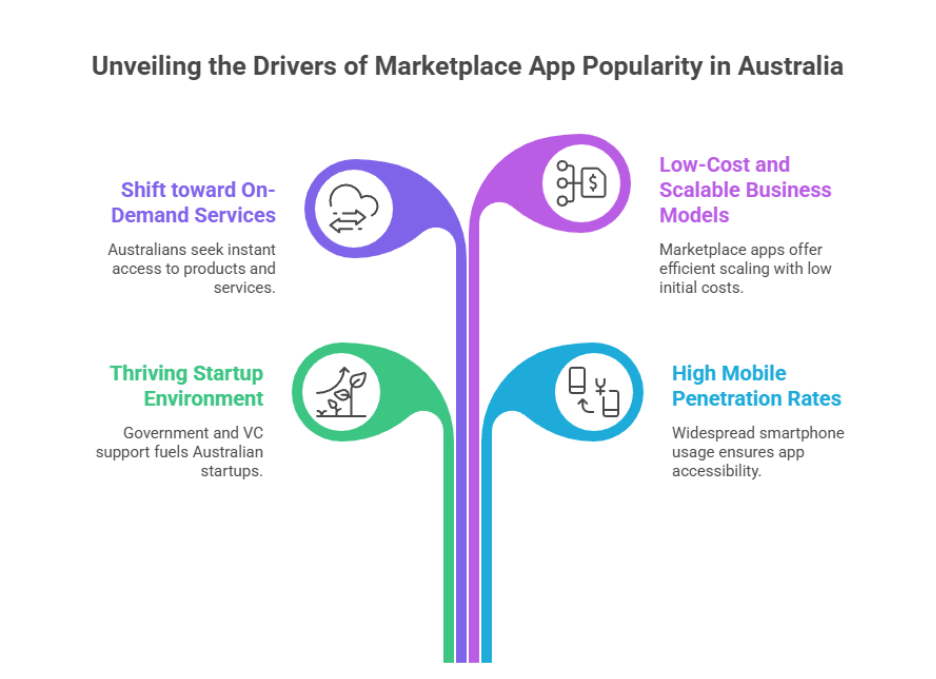
Several factors are driving this growth:
- Thriving Startup Ecosystem: Government initiatives, accelerators, and venture capital continue to support innovative Australian startups.
- High Mobile Adoption: Consumers increasingly rely on mobile apps for shopping, bookings, and on-demand services.
- Growing Demand for Convenience: Services such as same-day delivery, remote consultations, and online marketplaces continue to gain popularity.
- Scalable Business Models: Marketplace platforms allow founders to scale efficiently without the burden of managing inventory or logistics.
The rise of no-code and low-code platforms has further accelerated this trend. Tools like FlutterFlow enable startups and enterprises to build scalable, high-quality marketplace applications faster and more cost-effectively than traditional development methods.
In this guide, we'll explore how businesses can leverage modern technologies and marketplace strategies to build successful, future-ready marketplace apps in Australia.
FlutterFlow empowers founders to build high-quality, scalable marketplace applications for iOS, Android, and the web from a single codebase. With seamless integrations for backend services, payment gateways, and third-party APIs, FlutterFlow enables startups to launch products faster while reducing development costs and complexity.
For Australian startups, this makes FlutterFlow an ideal platform for validating ideas, building MVPs, and scaling confidently as user demand grows. Its visual development environment accelerates development without compromising performance, flexibility, or future scalability.
In this guide, we'll walk through the complete process of marketplace app development in Australia using FlutterFlow—from selecting the right marketplace model and defining core features to scaling your platform and implementing best practices. Whether you're building a service marketplace, eCommerce platform, or on-demand app, this roadmap will help you create a scalable and successful marketplace application.
2. Marketplace Apps vs E-Commerce Apps: Key Differences
Marketplace and e-commerce apps can seem alike, but are built on entirely different business and technology models. It's very important to understand those differences when you are designing your app's architecture, choosing a revenue model for your app, and thinking about how scalable your app will be in the long term, especially if you are using Flutterflow marketplace app solutions.
Now let's look at some of the main differences.
2.1 Number of Sellers
Marketplace Apps
Marketplace platforms are designed to host multiple independent sellers or service providers on a single platform. Each seller manages their own listings, pricing, availability, and fulfillment, while the platform owner facilitates discovery, payments, and trust mechanisms. This approach is central to marketplace app development in Australia for businesses looking to create scalable multi-vendor solutions.
E-Commerce Apps
E-commerce apps typically operate with a single seller or brand. The business owns the products, controls pricing, and manages fulfillment directly.
➡️ Example:
Airbnb connects thousands of hosts to travelers, while a typical online store sells products from its own inventory.
2.2 Inventory Ownership
Marketplace Apps
The platform does not own inventory. Products or services are listed and fulfilled by third-party sellers. This significantly reduces operational overhead and allows rapid scaling, which is a key principle in marketplace app development guide practices.
E-Commerce Apps
The business owns, manages, and stores inventory, which requires warehousing, logistics, and inventory forecasting.
➡️ Why these matters:
Marketplace apps scale faster because growth depends on onboarding sellers, not stocking products.
2.3 Revenue Model (Commission, Subscription, Hybrid)
Marketplace Apps
Marketplace platforms typically generate revenue through:
- Commission per transaction
- Seller subscriptions
- Listing fees
- Hybrid monetization models
These are also relevant when building the best marketplace app in Australia.
E-Commerce Apps
Revenue is generated primarily through direct product sales, where profit margins depend on sourcing and inventory costs.
➡️ SEO Tip: “commission-based marketplace app” and “subscription marketplace model” are high-intent keywords.
2.4 Product & Service Variety
Marketplace Apps
Marketplaces offer a wide variety of products or services, often across multiple categories, depending on the sellers onboarded. This flexibility makes the Flutterflow marketplace app an ideal choice for startups seeking quick and scalable development.
E-Commerce Apps
Product offerings are limited to what the brand stocks or manufactures.
➡️ Result:
Marketplaces can expand rapidly into new categories without redesigning the core app structure.
2.5 Overall Business Model Comparison
Marketplace Apps
- Asset-light business model
- Faster geographic and category expansion
- Strong network effects
- Requires robust seller management & trust systems
E-Commerce Apps
- Asset-heavy business model
- Higher upfront investment
- Linear growth model
- Full control over supply chain
Marketplace App vs E-Commerce App: Quick Comparison Table
Why This Difference Matters When Using FlutterFlow
FlutterFlow marketplace app solutions are particularly well-suited for marketplace app development in Australia because they support:
- Multi-role user management (buyers, sellers, admins)
- Dynamic data models
- Scalable backend integrations
- Complex workflows like commission payouts and approvals
Understanding whether your idea is a marketplace or an e-commerce app helps you design the right architecture from day one—saving time, cost, and rework as your app grows. Using a Flutterflow marketplace app can also make this process faster and more efficient, following best practices outlined in any marketplace app development guide for building the best marketplace app in Australia.
3. Why Choose FlutterFlow for Marketplace App Development?
Building an appropriate technology stack is one of the key factors for the success of any marketplace app development in Australia. Australian startups require a development methodology that allows them to develop rapidly, cost-effectively, and with scalability, all while providing a high level of performance and user experience.
Flutterflow marketplace app solutions can do this. It is a powerful no-code and low-code app development platform built upon the Flutter framework from Google. The platform allows business owners to build high-quality Flutterflow marketplace app solutions at a much faster pace than other methodologies.
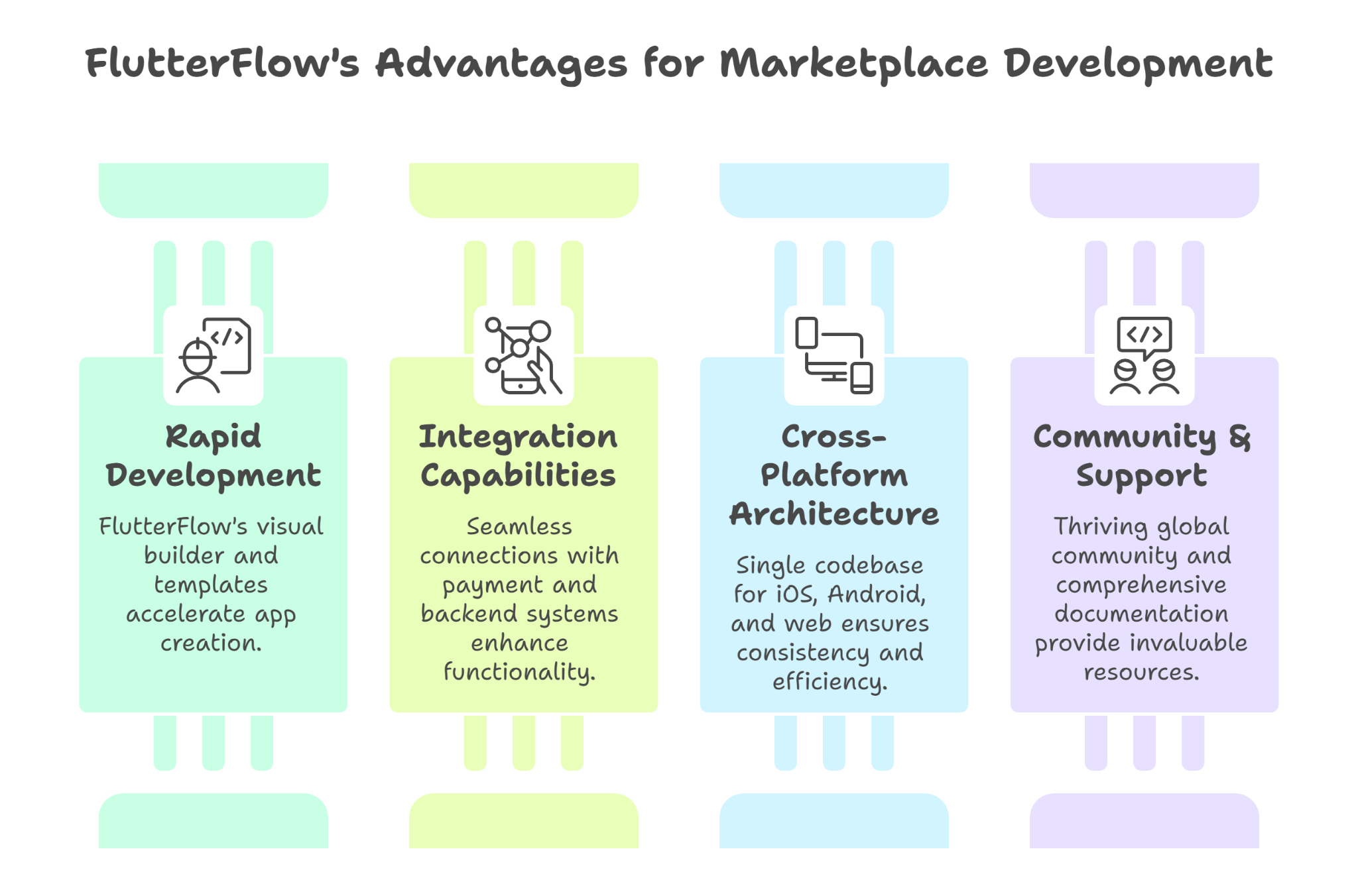
3.1 Rapid Marketplace App Development with FlutterFlow
FlutterFlow allows developers to create Flutterflow marketplace app applications at an incredible pace, which is one of its largest advantages. By allowing developers to go from idea to launch very quickly, FlutterFlow is excellent for creating MVPs and for fast-growing startups, following best practices in any marketplace app development guide.
- Visual UI Builder – The visual UI builder within FlutterFlow enables developers and non-technical founders to build pixel-perfect user interfaces by dragging and dropping various UI components into their application without having to write large amounts of code. This visual-first approach greatly minimizes design-to-development gaps and allows for much faster iteration cycles—especially critical for testing new marketplace app development in Australia concepts in highly competitive marketplaces.
- Ready-to-use marketplace templates – FlutterFlow has built-in templates and reusable components that enable Flutterflow marketplace app applications to be developed much faster. These templates contain many marketplace-specific components, such as:
a) User authentication screens
b) Product or service listing layouts
c) Seller profile pages
d) Booking and order flows
Using these templates allows developers to focus more on the business logic and differentiators for their Flutterflow marketplace app and less on building the common elements of a marketplace application.
- Beginner-friendly no-code/low-code – FlutterFlow offers a unique blend of no-code ease of use and low-code flexibility. Non-technical users can build fully-functional Flutterflow marketplace app solutions using visual logic and workflows; however, if they need additional functionality, they can extend that functionality by adding custom Dart code to their project.
The hybrid approach offered by FlutterFlow enables Australian startups to:
a) Reduce development cost
b) Shorten time-to-market
c) Allow for flexibility when scaling in the future
Regardless of whether the developer is creating a quick MVP or developing a full-scale Flutterflow marketplace app, FlutterFlow will adapt to meet both their technical and business needs, ensuring they can follow a proven marketplace app development guide to create the best marketplace app in Australia.
3.2 Powerful Integration Capabilities
When you are developing a marketplace app development in Australia, there are many different ways to design and develop your app. The success of your Flutterflow marketplace app will be based on how well it is able to connect and interact with other applications and services, such as the payment system, back-end system, and third-party applications.
Flutterflow marketplace app solutions have made it very easy to create a connection with all these types of applications through robust integration capabilities. With the Flutterflow marketplace app, you can create a high-quality and scalable marketplace app development in Australia.
Regardless of whether you're just launching your first version of your app (MVP) or planning to grow your app to thousands of users, Flutterflow marketplace app provides the ability to link together the necessary applications and services to support your app without requiring a large amount of custom programming or complicated setup procedures, following best practices from any marketplace app development guide for creating the best marketplace app in Australia.
Payment Applications: Stripe (Australia) & PayPal
Stripe is a highly popular and reliable payment gateway application throughout Australia. It offers a variety of secure methods to allow buyers to purchase products, including:
- Card payments
- Recurring subscription payments
- Commission-based payment for vendors and the platform owner
- Split payments
With the ability to use both Stripe and PayPal within the Flutterflow marketplace app, marketplace owners have the flexibility to provide a variety of payment options to meet the changing needs of their customers. This can increase customer confidence and checkout conversion rates.
For Flutterflow marketplace app platforms, the payment integrations provide the capability to create an escrow-type environment that allows for the automatic payment of funds to the vendor and also provides transparency to the marketplace owner regarding each transaction, making it an essential consideration for any marketplace app development in Australia, following a proven marketplace app development guide to build the best marketplace app in Australia.
Back End Solutions: Firebase, Supabase & Xano
Flutterflow marketplace app provides a smooth integration experience with several backend solution providers to ensure that founders can select the architecture that meets their specific needs for scalability and compliance.
- Firebase is a good option when creating an MVP quickly and requires real-time data and/or authentication, making it ideal for early-stage marketplace app development in Australia.
- Supabase is a great option when a scalable database is required, along with a solid authentication solution and enterprise-ready scalability for Flutterflow marketplace app solutions.
- Xano is a great option when a Flutterflow marketplace app requires advanced back-end logic and/or workflow automation.
The above back-end solutions provide the following key features to support the complexity of a Flutterflow marketplace app:
- Multi-user role management (vendors, buyers, administrators)
- Secure authentication and authorization
- Real-time updates for orders, bookings, and inventory levels
- Ability to scale with your growing data needs
Using these back-end options ensures that startups following a marketplace app development guide can build the best marketplace app in Australia with robust performance, security, and scalability.
Integration with Third Party APIs: Maps, Notifications & Analytics
In general, marketplace apps require the use of third-party APIs to deliver a seamless user experience. Flutterflow marketplace app development makes it easy to integrate with various third-party APIs, such as:
- Maps & Location Services (Google Maps) to support delivery and service discovery and proximity-based search
- Push notifications to notify users of updates to their orders, booking confirmations, and promotional messages
- Analytic tools to analyze user behavior, conversions, and performance metrics for vendors
These integrations help marketplace owners to optimize user engagement and improve operational efficiency while making data-driven decisions from day one, which is a core principle of marketplace app development in Australia.
Why Integrations Are Important for Building a Scalable Marketplace
Supporting the flexible integration of payments, back-end services, and external APIs, the Flutterflow marketplace app enables your marketplace app to be "future-proof." When your platform grows, you will be able to extend its functionality, add new services, or replace backend components without having to rebuild your entire application.
Due to this integration-first approach, the Flutterflow marketplace app is the ideal choice for Australian startups who wish to follow a proven marketplace app development guide and build the best marketplace app in Australia that is scalable, secure, and feature-rich.
3.3 Cross-Platform & Scalable Architecture
The key to building a successful marketplace application is using an architecture that is both cross-platform and scalable. Marketplace platforms will grow rapidly, and therefore, it is important to use technology that will be able to grow along with them and provide seamless scaling across multiple devices and user levels, especially when competing against other similar platforms in marketplace app development in Australia.
Single Codebase for iOS, Android & Web
As FlutterFlow uses Google's Flutter platform, it allows you to build high-performance applications while also providing long-term scalability right from the beginning, making it ideal for Flutterflow marketplace app development.
With FlutterFlow, you can build applications for iOS, Android, and web from one single codebase. This provides significant reductions in development time and cost to maintain, which is a key advantage highlighted in any marketplace app development guide. Instead of having to manage multiple teams or platforms, you can roll out changes and feature enhancements across all platforms at the same time. This single codebase allows for:
- Faster release and iteration cycles
- A consistent user experience across platforms
- Lower long-term costs associated with maintaining your applications
When developing applications to reach users across both mobile and web, this unified development process offers a significant strategic advantage for marketplace app development in Australia.
Optimized Performance for High-Traffic Marketplaces
Many marketplace applications experience irregular traffic patterns (e.g., during promotions, peak hours, or seasonal demand). As Flutterflow marketplace app solutions utilize the high-performance rendering engine found in Flutter, they deliver fast and smooth user interface experiences even during periods of heavy usage.
In addition, the scalable backend integration options provided by FlutterFlow help support:
- Fast loading times
- Efficient state management
- Real-time data updates
- Reliable performance as the number of users and sellers grows
This makes Flutterflow marketplace app development well-suited for large-scale, high-traffic, transaction-based platforms aiming to become the best marketplace app in Australia.
Trusted by Startups & Enterprises Using Flutter
Trustworthy Solution Used by Both Startups and Enterprise-Level Organizations Utilizing Flutter
Google's Flutter has been adopted by thousands of startups and enterprise-level organizations around the world across various industries, demonstrating Flutter's reliability at scale. Many well-known digital products rely on Flutter's ability to provide high-performance and cross-platform capabilities to support millions of users worldwide.
Using the Flutterflow marketplace app to develop your marketplace application allows you to benefit from:
- Enterprise-grade architecture
- Long-term support from the underlying framework
- A growing community of tool providers and developers
The widespread use and support for Flutter make FlutterFlow a reliable and future-proof solution for Australian startups looking to follow a proven marketplace app development guide and build scalable marketplace applications with confidence as part of marketplace app development in Australia.
3.4 FlutterFlow Community & Enterprise Support
Beyond its technological capabilities and the various features included in a marketplace application, long-term success will be influenced by the quality of the supporting ecosystem. With its continually growing support network, and the fact that FlutterFlow has a thriving global community of no-code builders, Flutter developers, startup founders, and enterprise teams, Flutterflow marketplace app development is a viable option for both startups and enterprises focused on marketplace app development in Australia.
Global Developer Community
FlutterFlow has a large and rapidly expanding global developer community of no-code builders, Flutter developers, startup founders, and enterprise teams. As such, this community has developed best practices for marketplace applications and shares custom workflows and reusable components, performance optimization techniques, and real-world examples of how to solve problems related to marketplace applications.
For Australian startups following a marketplace app development guide, this represents rapid access to answers, innovation driven through the community, and decreased dependence on independent development efforts—key factors when building the best marketplace app in Australia.
Documentation & Support Network
FlutterFlow has a wealth of documentation, tutorials, and training materials available that address everything from setting up your first app to the most complex marketplace workflows. Through the structured learning environment provided by FlutterFlow, teams can onboard new members more quickly, reduce errors during development, and confidently implement complex features into a Flutterflow marketplace app.
In addition, FlutterFlow includes direct support options and regular platform releases that ensure your application remains compatible with changes in technology and app store requirements—an essential consideration for long-term marketplace app development in Australia.
Importance of Community & Support to Marketplace Applications
Marketplace applications are among the most technically demanding types of applications. These applications include multiple user roles, payment processing, and real-time interactions. Therefore, having access to a strong community and support ecosystem decreases technical risks and allows entrepreneurs to focus on business growth rather than troubleshooting.
Through the community-driven knowledge base and enterprise-ready support of the Flutterflow marketplace app, Australian businesses can confidently develop, deploy, and scale their platforms by following a proven marketplace app development guide and working toward building the best marketplace app in Australia.
4. Types of Marketplace Apps You Can Build Using FlutterFlow
Using FlutterFlow's versatility, there is an endless variety of types of marketplace applications that can be created for a multitude of industries and products. Whether your app targets physical products, services, or consulting services, Flutterflow marketplace app development allows for a wide variety of workflows, multi-vendor management, and scalable backend integrations—making it a strong choice for marketplace app development in Australia.
Let's go over a few of the many product-based marketplace apps that can be created with FlutterFlow.
4.1 Product Marketplace Apps Built with FlutterFlow
Product marketplace applications allow multiple sellers to sell both physical and/or digital products on a single platform. The marketplace owner is responsible for managing the customer experience, including discovery, payment processing, commission tracking, and maintaining user trust. The marketplace model, which includes product marketplace apps, is one of the most popular and scalable marketplace models in the world today and is widely referenced in any marketplace app development guide.
FlutterFlow has all of the necessary components and tools needed to create product marketplace apps efficiently. With Flutterflow marketplace app solutions, you can create complex product catalogs, multi-vendor workflows, and support high-volume transactions—whether you are delivering food, enabling grocery shopping, or offering healthcare products to consumers across Australia.
Food Delivery Marketplace Apps
Food delivery marketplace apps connect customers with restaurants, cloud kitchens, or food vendors, enabling users to browse menus, place orders, and receive deliveries through a unified platform. These apps rely heavily on real-time data, location services, and payment automation and are a major segment of marketplace app development in Australia.
Core Features of Food Delivery Marketplaces:
- Restaurant onboarding and profile management
- Dynamic menu creation with pricing and availability
- Real-time order placement and tracking
- Integrated online payments and refunds
- Ratings, reviews, and order history
Popular Examples Explained:
DoorDash
DoorDash operates as a multi-vendor food delivery marketplace where thousands of restaurants list their menus. Customers browse nearby options, place orders, and track deliveries in real time. The platform earns revenue through commissions charged to restaurants and delivery fees paid by customers.
Uber Eats
Uber Eats combines food discovery, logistics, and payments into a single ecosystem. Restaurants manage menus and availability, while customers benefit from location-based search, estimated delivery times, and seamless in-app payments.
How FlutterFlow Fits In
Using the Flutterflow marketplace app, similar food delivery marketplaces can be built with:
- Location-based restaurant discovery using Maps APIs
- Dynamic menu and pricing updates via backend integrations
- Order workflows and push notifications
- Stripe-powered payments and commission logic
This makes Flutterflow marketplace app development suitable for both local food delivery startups in Australia and region-wide platforms aiming to follow a proven marketplace app development guide and compete among the best marketplace apps in Australia.
Grocery Delivery Marketplace Apps
Grocery delivery marketplaces allow customers to order daily essentials from multiple grocery stores or supermarkets through a single app. Unlike food delivery, these platforms often deal with large product catalogs, frequent inventory updates, and scheduled deliveries, making them a strong use case for marketplace app development in Australia.
Core Features of Grocery Marketplaces:
- Multi-store product listings
- Real-time stock availability
- Scheduled or same-day delivery options
- Subscription or membership plans
- Order substitutions and refunds
Popular Examples Explained:
Instacart
Instacart connects users with local grocery stores, allowing customers to shop from multiple retailers within one app. The platform manages payments, delivery coordination, and customer support while stores focus on inventory and fulfillment.
Shipt
Shipt operates on a membership-based grocery marketplace model, offering scheduled deliveries from partnered stores. Its success lies in logistics optimization, user experience, and reliable order fulfillment.
How FlutterFlow Fits In
Flutterflow marketplace app solutions support grocery marketplaces by enabling:
- Scalable database structures for large product catalogs
- Inventory syncing via backend services like Supabase or Xano
- Complex order workflows with substitutions
- Subscription-based monetization using Stripe
This makes Flutterflow marketplace app development ideal for on-demand grocery delivery apps targeting Australian metro and suburban markets and following a proven marketplace app development guide.
Pharmacy & Healthcare Product Marketplaces
Pharmacy and healthcare marketplaces focus on delivering medicines, wellness products, and health-related essentials through a secure and compliant platform. These apps prioritize trust, verification, and secure data handling and are an increasingly important segment of marketplace app development in Australia.
Core Features of Pharmacy Marketplaces:
- Verified pharmacy or seller onboarding
- Secure authentication and payments
- Prescription upload and approval workflows (if applicable)
- Order tracking and delivery updates
- Compliance-focused data storage
Popular Examples Explained:
CVS Pharmacy
CVS Pharmacy enables users to order medications, manage prescriptions, and access healthcare products digitally. The platform integrates pharmacy services with user accounts, ensuring secure and regulated transactions.
Walgreens
Walgreens combines e-commerce and marketplace functionality by allowing users to browse health products, refill prescriptions, and schedule deliveries through a unified digital experience.
How FlutterFlow Fits In
With the Flutterflow marketplace app, healthcare marketplaces can be built using:
- Secure user authentication and role-based access
- Backend validation workflows for prescriptions
- Encrypted data storage through reliable backend services
- Controlled seller onboarding and verification processes
This allows startups to build healthcare-focused platforms by following a structured marketplace app development guide and working toward creating the best marketplace app in Australia while maintaining scalability, compliance, and user trust.
Why Product Marketplaces Are Ideal for FlutterFlow
Product marketplace apps are complex, but Flutterflow marketplace app development simplifies the process by offering:
- Visual workflows for order and payment management
- Multi-role user support (buyers, sellers, admins)
- Seamless third-party integrations
- Cross-platform deployment from a single codebase
For founders in Australia looking to validate, launch, and scale product-based marketplaces quickly, Flutterflow marketplace app solutions support faster execution and long-term scalability. By following a proven marketplace app development guide, startups can confidently approach marketplace app development in Australia and work toward building the best marketplace app in Australia with the right balance of speed, flexibility, and performance.
4.2 Service Marketplace Apps Built with FlutterFlow
Apps that operate as a service marketplace enable individuals to find and access services by connecting consumers with service providers, such as contractors and consultants, rather than focusing on goods like traditional retail platforms. With a strong emphasis on availability, scheduling, trust, and communication, service marketplaces are perfectly positioned for today’s on-demand service-based economy and are a major segment of marketplace app development in Australia.
Flutterflow marketplace app development is flexible enough to support service-based platforms, allowing founders to create features such as live booking, provider dashboards, and secure payment processing from a single codebase, following best practices outlined in any marketplace app development guide.
Home & On-Demand Service Marketplaces
Home and on-demand service marketplaces allow users to find and book local professionals for tasks such as cleaning, repairs, moving, or maintenance, and are increasingly popular within marketplace app development in Australia.
Core Features of Home Service Marketplaces:
- Service provider onboarding and verification
- Location-based service discovery
- Instant booking or scheduled appointments
- Secure in-app payments
- Ratings and reviews
Popular Examples Explained:
Thumbtack
Thumbtack connects users with local professionals across multiple categories, from plumbing to event planning. Customers post job requirements, and service providers respond with quotes, allowing users to compare options before booking.
TaskRabbit
TaskRabbit focuses on on-demand task fulfillment, enabling users to book verified professionals for everyday tasks. Its success lies in seamless booking flows, transparent pricing, and reliable service delivery.
How FlutterFlow Fits In
Using the Flutterflow marketplace app, home service marketplaces can be built with:
- Location-based matching using Maps APIs
- Booking and scheduling workflows
- Provider availability management
- Commission-based payment handling
This makes Flutterflow marketplace app development ideal for local and regional service marketplaces across Australia, aiming to become the best marketplace app in Australia.
Beauty & Fashion Service Marketplaces
Beauty and fashion service marketplaces connect customers with professionals offering services such as hairstyling, makeup, grooming, and personal styling—either in salons or at home.
Core Features of Beauty Marketplaces:
- Professional profile and portfolio management
- Appointment scheduling
- Service packages and pricing
- Secure payments and tipping options
Popular Examples Explained:
Glamsquad
Glamsquad offers on-demand beauty services delivered at home or on location. Users browse services, select professionals, and book appointments through a streamlined mobile experience.
StyleSeat
StyleSeat empowers beauty professionals to manage bookings, payments, and customer relationships through a marketplace platform that also supports discovery and scheduling.
How FlutterFlow Fits In
Flutterflow marketplace app solutions support beauty marketplaces by enabling:
- Custom booking calendars
- Dynamic service listings
- Automated reminders and notifications
- Payment splitting between professionals and platform owners
This makes FlutterFlow well-suited for salon, wellness, and fashion-focused marketplaces following a structured marketplace app development guide.
Freelancer & Gig Marketplace Platforms
Freelancer marketplaces connect businesses with independent professionals offering services such as design, development, marketing, and consulting. These platforms rely heavily on profile credibility, secure payments, and communication tools and are a fast-growing area of marketplace app development in Australia.
Core Features of Freelancer Marketplaces:
- Freelancer profiles with portfolios
- Job posting and bidding workflows
- Secure escrow-style payments
- Messaging and file sharing
- Reviews and ratings
Popular Examples Explained:
Upwork
Upwork enables businesses to hire freelancers globally, offering features such as proposals, milestone-based payments, and dispute resolution to ensure trust on both sides.
Fiverr
Fiverr simplifies freelancing by allowing service providers to list predefined “gigs” with clear pricing and delivery timelines, making it easy for clients to purchase services quickly.
How FlutterFlow Fits In
With the Flutterflow marketplace app, freelancer marketplaces can be built using:
- Multi-role user systems (clients, freelancers, admins)
- Secure escrow and milestone payment workflows
- Real-time messaging integrations
- Scalable backend support for large user bases
This makes Flutterflow marketplace app an excellent choice for gig economy and freelance platforms targeting Australian and global markets while following a proven marketplace app development guide and aiming to build the best marketplace app in Australia.
Why Service Marketplaces Thrive on FlutterFlow
Service marketplaces demand flexibility, real-time interactions, and trust-based systems. Flutterflow marketplace app development delivers all of this through:
- Visual logic for bookings and payments
- Cross-platform deployment
- Scalable backend integrations
- Rapid iteration and feature rollout
For founders looking to launch service-based marketplace apps as part of marketplace app development in Australia, Flutterflow marketplace app solutions provide the speed and reliability needed to compete and scale. By following a structured marketplace app development guide, startups can confidently work toward building the best marketplace app in Australia with strong performance and long-term scalability.
4.3 Consultation-Based Marketplace Apps Built with FlutterFlow
Consultation-based marketplaces allow users to connect directly with experts, specialists, or professionals through one-on-one or scheduled consultations. These platforms are widely used across education, healthcare, legal, and professional service industries where secure communication, trust, and access to expert knowledge are critical.
Flutterflow marketplace app development is a strong fit for consultation-focused platforms, as FlutterFlow makes it easy to implement essential features such as scheduling, payments, role-based access, and secure backend integrations—without slowing down time to market.
Education & Tutoring Consultation Platforms
Education and tutoring consultation marketplaces enable students to connect with qualified tutors or educators for live classes, doubt-solving sessions, or long-term learning programs.
Core Features of Education Consultation Marketplaces
- Tutor onboarding and profile verification
- Subject-wise tutor discovery
- Session scheduling and availability management
- Secure payments per session or via subscriptions
- Ratings, reviews, and student learning history
Popular Examples Explained
Chegg Tutors
Chegg Tutors connects students with tutors across multiple subjects for real-time, one-on-one learning. The platform focuses on instant access to qualified tutors, flexible pricing, and seamless scheduling.
Wyzant
Wyzant offers a personalized tutoring marketplace where students can choose tutors based on experience, ratings, and subject expertise. It supports hourly pricing, long-term tutoring relationships, and transparent review systems.
How FlutterFlow Fits In
Using FlutterFlow, education consultation marketplaces can be built with:
- Tutor profiles and verification workflows
- Booking systems with calendar integrations
- Secure per-session or subscription-based payments
- In-app messaging and notification systems
This makes Flutterflow marketplace app solutions ideal for edtech consultation platforms targeting Australian students as well as global learners.
Doctor & Telehealth Consultation Marketplace Apps
Telehealth consultation marketplaces connect patients with doctors, specialists, or healthcare providers through virtual appointments. These platforms place a strong emphasis on security, compliance, and reliability.
Core Features of Telehealth Marketplaces
- Verified doctor onboarding and credential checks
- Appointment scheduling and automated reminders
- Secure payments and billing workflows
- Medical history and consultation records
- Privacy-first and compliant data handling (where applicable)
Popular Examples Explained
Teladoc
Teladoc allows patients to consult licensed healthcare professionals through virtual appointments. The platform integrates scheduling, payments, and medical documentation to deliver seamless digital healthcare experiences.
Zocdoc
Zocdoc focuses on helping patients find and book doctors based on availability, specialization, and location. It emphasizes transparency, verified reviews, and ease of booking.
How FlutterFlow Fits In
FlutterFlow supports telehealth consultation marketplaces by enabling:
- Role-based access control for patients and doctors
- Secure authentication and data handling
- Appointment booking and notification workflows
- Integration with compliant backend services
This enables startups to build scalable, secure, and user-friendly telehealth platforms as part of marketplace app development in Australia.
Why Consultation Marketplaces Work Well with FlutterFlow
Consultation-based marketplaces require precise scheduling, secure payments, and smooth real-time communication. FlutterFlow simplifies this complexity through:
- Visual workflows for bookings and payments
- Backend integrations for secure data management
- Cross-platform deployment for mobile and web
- Flexibility to extend features as regulations and user needs evolve
By following a structured marketplace app development guide, founders can confidently use FlutterFlow to build consultation platforms that scale efficiently. For Australian founders aiming to launch trusted platforms in education or healthcare, FlutterFlow offers the foundation needed to create the best marketplace app in Australia with speed, security, and long-term flexibility.
5. Best Practices for Marketplace App Development Using FlutterFlow
Building a marketplace app goes far beyond UI and basic functionality. Long-term success depends on performance, scalability, user experience, and trust—especially when managing multiple sellers and high transaction volumes.
As outlined in this Marketplace app development guide, FlutterFlow provides the tools needed to build robust marketplace platforms, but following the right best practices ensures your app performs reliably as it grows—especially for Marketplace app development in Australia.
5.1 Performance Optimization
Performance is critical for marketplace apps, as slow load times or app crashes directly impact user trust and conversion rates—key factors when building the best marketplace app in Australia.
Efficient Data Handling
Marketplace apps deal with large volumes of dynamic data, including listings, user profiles, orders, and reviews. In FlutterFlow:
- Use optimized queries to fetch only required data
- Implement pagination for long lists
- Avoid unnecessary real-time listeners for static content
This ensures faster load times and a smoother user experience for any Flutterflow marketplace app.
Load Balancing Strategies
As traffic increases, backend performance becomes crucial. Pairing FlutterFlow with scalable backend solutions such as Supabase, Firebase, or Xano allows workloads to be distributed efficiently—an essential consideration for Marketplace app development in Australia.
Best practices include:
- Separating read-heavy and write-heavy operations
- Using cloud-based backend infrastructure
- Monitoring API performance and response times
Cross-Device Testing
Marketplace apps are accessed across a wide range of devices and screen sizes. FlutterFlow’s cross-platform nature makes it easier to:
- Test UI responsiveness across iOS, Android, and web
- Ensure consistent layouts on different screen resolutions
- Validate navigation and user flows across devices
This is critical when delivering a production-ready Flutterflow marketplace app.
Stress & Regression Testing
Before launch and during major updates:
- Perform stress testing to evaluate app behavior under peak traffic
- Conduct regression testing to ensure new features don’t break existing workflows
This helps maintain app stability as features evolve and supports long-term scalability for the best marketplace app in Australia.
5.2 Designing for Scalability
Scalability should be planned from day one, especially for marketplace apps that grow through seller onboarding and network effects—an important principle highlighted in any comprehensive Marketplace app development guide.
Modular Database Structure
Design your database in a modular way by separating:
- Users (buyers, sellers, admins)
- Listings or services
- Orders, bookings, and payments
This structure makes it easier to expand features without redesigning the entire system, supporting scalable Marketplace app development in Australia.
Backend Scalability Planning
FlutterFlow’s backend-agnostic approach allows you to start small and scale over time. Best practices include:
- Choosing scalable databases (SQL or NoSQL, based on use case)
- Implementing role-based access control
- Preparing for horizontal scaling as user volume grows
These practices ensure your Flutterflow marketplace app can grow reliably as demand increases.
5.3 User Experience (UX) Best Practices
User experience plays a major role in customer retention and seller satisfaction in marketplace platforms—especially when aiming to build the best marketplace app in Australia.
Consistent Cross-Platform UI
With FlutterFlow, maintaining a consistent UI across mobile and web is easier through reusable components and design systems. This consistency builds brand trust and improves usability, which is essential for any Flutterflow marketplace app.
Smooth Onboarding Flows
First impressions matter. Marketplace apps should:
- Minimize friction during signup
- Clearly explain value propositions for buyers and sellers
- Guide users through essential steps with tooltips or walkthroughs
A well-designed onboarding flow increases activation rates and supports successful Marketplace app development in Australia.
Personalized User Journeys
Personalization helps marketplaces stand out. FlutterFlow enables:
- Role-based dashboards
- Personalized recommendations
- Location-aware content
These features improve engagement and conversion, reinforcing best practices outlined in any Marketplace app development guide.
5.4 Seller Verification & Trust Mechanisms
Trust is the backbone of any marketplace app. Users must feel confident when interacting with sellers or service providers—particularly when building the best marketplace app in Australia.
Document Submission Workflows
Implement seller verification processes by:
- Collecting identity or business documents
- Using approval workflows
- Restricting access until verification is complete
FlutterFlow supports such workflows through backend logic and role management, making it well-suited for secure Flutterflow marketplace app development.
Review & Rating Systems
Transparent review systems help users make informed decisions and encourage sellers to maintain quality standards. These systems should be:
- Tamper-resistant
- Visible across listings
- Integrated into search and discovery
This directly impacts credibility in Marketplace app development in Australia.
Fraud Detection & Moderation
Marketplace platforms should actively monitor for suspicious behavior. Best practices include:
- Flagging abnormal transaction patterns
- Manual and automated moderation workflows
- Clear dispute resolution mechanisms
These safeguards are critical for scalable platforms highlighted in a comprehensive Marketplace app development guide.
Why These Best Practices Matter
Following these marketplace app development best practices ensures your FlutterFlow app is:
- Fast and reliable
- Ready to scale
- Easy to use
- Trusted by users and sellers
For Australian startups, applying these principles early reduces technical debt and creates a strong foundation for long-term growth in Marketplace app development in Australia, helping position the product as the best marketplace app in Australia.
6. Core Features Required for a Successful Marketplace App
To build a scalable marketplace app that users will trust, you need a solid foundation in terms of core features. These can be product-focused, service-focused, or consultation-focused. Regardless of focus, these features provide a strong base for transactional security, operational efficiency, and a seamless user experience—key goals for Marketplace app development in Australia.
The key advantage of using FlutterFlow is the ease with which each of these features can be implemented. This makes FlutterFlow an ideal tool for both Australian startups and enterprises looking to build a Flutterflow marketplace app that can scale into the best marketplace app in Australia.
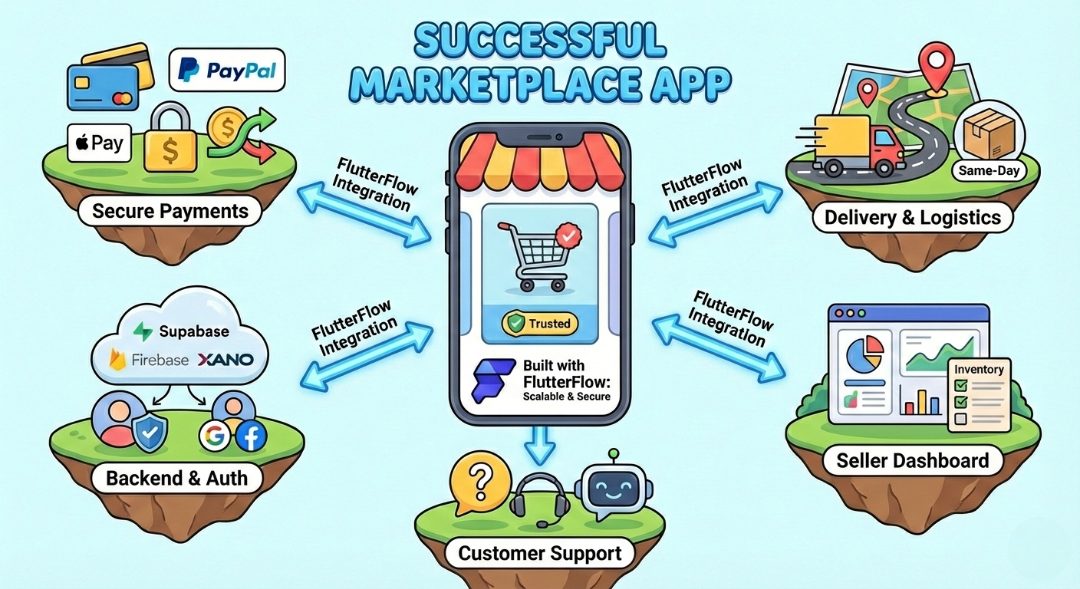
6.1 Secure Payment Integration
Secure and flexible payment systems are essential for building trust with both buyers and sellers in any Marketplace app development guide.
Key Components:
- Multiple Payment Methods: Support credit/debit cards, digital wallets (e.g., PayPal, Apple Pay), and regional options such as Stripe (Australia).
- Secure Transactions & Escrow: Implement encrypted transactions and escrow functionality to protect both buyers and sellers during orders.
- Automated Payment Splitting: Automatically split payments between sellers and platform owners for commission-based models.
FlutterFlow Advantage:
FlutterFlow integrates seamlessly with Stripe, PayPal, and other payment APIs, allowing you to configure complex payment flows visually without heavy custom coding—an important advantage for Marketplace app development in Australia.
6.2 Backend Connectivity & User Authentication
A marketplace’s backend must reliably handle users, transactions, and dynamic data to support scalable growth.
Key Components:
- Reliable Backend Architecture: Use Supabase, Firebase, or Xano to ensure scalable, secure, and real-time backend support.
- User Authentication: Support email, social logins (Google, Apple, Facebook), and OTP verification for fast and secure onboarding.
FlutterFlow Advantage:
FlutterFlow supports multi-role authentication (buyers, sellers, admins) and integrates seamlessly with backend services, enabling real-time data updates, dynamic workflows, and secure access control—core requirements of a robust Flutterflow marketplace app.
6.3 Same-Day Delivery & Logistics (If Applicable)
For product marketplaces, smooth logistics and transparent delivery tracking improve trust and retention, especially for platforms aiming to become the best marketplace app in Australia.
Key Components:
- Order Summaries & Tracking: Real-time order updates, delivery tracking, and notifications.
- Easy Cancellations & Returns: Simplified workflows for order cancellations, returns, and refunds.
FlutterFlow Advantage:
By connecting FlutterFlow to Maps APIs, delivery services, and backend workflows, you can create a dynamic logistics system with automated updates and notifications—an important capability in modern Marketplace app development in Australia.
6.4 Seller Dashboard & Admin Controls
Marketplace platforms must empower sellers while giving administrators full control over platform operations.
Key Components:
- Inventory Management: Add, update, and track product or service listings.
- Sales & Revenue Analytics: Monitor sales, commissions, and performance metrics.
- Order & Payout Management: Manage orders, automate payouts, and maintain financial transparency.
FlutterFlow Advantage:
FlutterFlow supports custom dashboards with analytics, order management workflows, and real-time data updates, enabling sellers and admins to manage their marketplace efficiently—an essential element outlined in any Marketplace app development guide.
6.5 Customer Support & Engagement
Providing strong customer support and engagement mechanisms is key to long-term marketplace success.
Key Components:
- Live Chat & Ticketing: Real-time support to handle queries, complaints, and guidance.
- Help Center & FAQs: Self-service knowledge base for common issues.
- AI-Powered Chatbots: Automate responses to routine queries and improve user engagement.
FlutterFlow Advantage:
With FlutterFlow, you can integrate chat systems, AI chatbots, and ticketing workflows visually, reducing the need for separate apps or complex coding—making it easier to deliver a polished Flutterflow marketplace app.
Why These Features Matter
By implementing these core features, your marketplace app will be:
- Secure and trustworthy for users and sellers
- Efficient and scalable for long-term growth
- User-friendly and engaging to retain customers
FlutterFlow provides a fast, reliable, and flexible platform to build all these features in one cross-platform codebase, making it an ideal choice for Marketplace app development in Australia and for founders aiming to launch the best marketplace app in Australia.
7. Marketplace App Case Studies: What You Can Learn
Studying successful marketplace apps provides invaluable lessons for founders building their own platforms, especially when following a proven Marketplace app development guide. Let’s explore some well-known examples and the strategies that made them thrive—insights that are highly relevant to Marketplace app development in Australia.
7.1 Airbnb – Trust & Community-Led Growth
Overview:
Airbnb transformed the travel industry by enabling homeowners to rent out their spaces to travelers. Its success is built on trust, user reviews, and community engagement, setting a benchmark for what many consider the best marketplace app in Australia-style experience in terms of usability and trust.
Key Features & Strategies:
- Verified user profiles for hosts and guests
- Transparent review and rating system
- Easy booking and secure payment workflow
- Community-driven support and guidelines
Lesson for Marketplace Apps:
Trust mechanisms and strong community engagement are crucial for platforms connecting multiple users, especially in high-risk or high-value transactions. FlutterFlow’s role-based authentication, review systems, and secure payment integrations make it easy to implement these features in a scalable Flutterflow marketplace app.
7.2 Etsy – Niche Product Marketplace Strategy
Overview:
Etsy is a marketplace for handmade, vintage, and unique products. Its focus on a niche market allows it to attract loyal buyers and sellers while scaling globally.
Key Features & Strategies:
- Personalized product recommendations
- Seller dashboards with inventory and analytics
- Search and filter functionality for easy discovery
- Community forums and seller support
Lesson for Marketplace Apps:
Focusing on a niche audience allows marketplaces to differentiate and grow sustainably. FlutterFlow supports customizable dashboards, advanced search, and category-specific workflows—key capabilities highlighted in any modern Marketplace app development guide.
7.3 Facebook Marketplace – Leveraging Existing Users
Overview:
Facebook Marketplace succeeded by tapping into Facebook’s existing user base. Users can buy and sell products without creating a new account, making adoption seamless.
Key Features & Strategies:
- Profile-based trust and social proof
- Seamless integration with existing platform features
- Real-time notifications and chat messaging
- Localized search and discovery
Lesson for Marketplace Apps:
Leveraging an existing audience reduces acquisition costs and accelerates adoption. FlutterFlow enables user authentication, social login integration, and chat features—important foundations for Marketplace app development in Australia, where competition is growing rapidly.
7.4 Walmart Business – B2B Marketplace Excellence
Overview:
Walmart Business focuses on connecting suppliers with retailers and businesses. Its success stems from efficient logistics, B2B-specific workflows, and robust backend systems.
Key Features & Strategies:
- Bulk ordering and pricing management
- Supplier dashboards with analytics
- Automated fulfillment and delivery tracking
- Secure payments and invoicing
Lesson for Marketplace Apps:
For B2B marketplaces, backend efficiency, analytics, and automated workflows are critical. FlutterFlow’s backend integrations, dashboards, and scalable architecture make these features feasible even for startups building a Flutterflow marketplace app.
Key Takeaways from Successful Marketplace Apps
From these case studies, you can extract four main principles that every marketplace app should follow when aiming to build the best marketplace app in Australia:
- Strong Niche Focus – Specializing in a category or service improves discoverability and engagement.
- Efficient Logistics & Operations – Smooth order management, payments, and delivery builds trust.
- Leveraging an Existing User Base – Using social or professional networks accelerates adoption.
- Clean, Intuitive UX Design – Easy onboarding, seamless navigation, and cross-platform consistency improve retention.
These lessons form a practical roadmap for founders following a structured Marketplace app development guide and investing in long-term Marketplace app development in Australia.
8. Why FlutterflowDevs Is the Right Partner for FlutterFlow Marketplace App Development
Creating an effective Marketplace App is about much more than just design. An application needs to be designed from the ground up to have a good user experience; it should be well-architected as a backend; it should integrate with other systems; it should scale; and most importantly, it should be able to support long-term growth. This is the foundation of successful Marketplace app development in Australia, and this is where FlutterflowDevs can assist you.
We are an Australian-based company that specializes in building end-to-end solutions using FlutterFlow and assist businesses worldwide to turn their marketplace ideas into fully operational, scalable, and profitable platforms—following a proven Marketplace app development guide refined through real-world experience.
8.1 Expert FlutterFlow Visual Development
At FlutterflowDevs, we leverage the visual development power of FlutterFlow to create beautiful, functional, and intuitive marketplace apps. Our expertise allows us to:
- Build visually stunning UIs: We craft apps that are not just functional, but visually compelling, with clean layouts, smooth animations, and consistent branding.
- Accelerate time-to-market: By using FlutterFlow’s no-code/low-code capabilities, we can prototype, iterate, and launch apps faster than traditional development methods.
- Ensure consistent UI across devices: With a single codebase for iOS, Android, and web, we guarantee that your users have a seamless experience, regardless of the device they use.
Whether you are launching a food delivery app, a freelancer platform, or a telehealth marketplace, our visual development expertise ensures your Flutterflow marketplace app looks professional, polished, and ready to impress users from day one.
8.2 Scalable Backend & Secure Architecture
A marketplace app’s success depends heavily on its backend architecture, which must support multi-user workflows, secure payments, real-time updates, and analytics. At FlutterflowDevs, we specialize in integrating FlutterFlow apps with robust backend solutions like Firebase, Supabase, and Xano.
With our backend expertise, your marketplace app can:
- Scale effortlessly: Our backend designs handle growth, allowing your platform to support more users, sellers, and transactions without compromising performance.
- Manage real-time data: Orders, bookings, and inventory updates are synchronized instantly across users and devices, ensuring a smooth and reliable experience.
- Ensure security and compliance: We implement role-based access, encrypted data handling, and secure authentication, giving your users and sellers peace of mind.
By combining FlutterFlow’s front-end flexibility with our backend expertise, we deliver enterprise-ready platforms aligned with best practices in Marketplace app development in Australia.
8.3 AI-Powered Marketplace Features
The modern marketplace is increasingly driven by personalization and intelligence. At FlutterflowDevs, we integrate AI capabilities into your marketplace app to enhance engagement, drive conversions, and optimize operations.
We help you implement:
- Personalized recommendations: Suggest products, services, or professionals based on user behavior, location, or past interactions.
- Intelligent search algorithms: Users can quickly find what they need, improving satisfaction and reducing drop-offs.
- AI chatbots and virtual assistants: Automate customer support, handle FAQs, and assist in order management.
- Dynamic pricing strategies: Use data-driven insights to optimize pricing for promotions, commissions, or subscription plans.
These AI-driven enhancements help you compete confidently while building what users expect from the best marketplace app in Australia.
8.4 Proven Marketplace App Delivery Experience
Experience matters when building complex, multi-vendor platforms. FlutterflowDevs has successfully delivered a variety of marketplace apps across industries, including:
- Custom feature implementation: Tailoring marketplaces for specific industries, whether it’s food delivery, health consultations, freelance platforms, or e-commerce.
- Optimized mobile and web experiences: Ensuring consistent performance and seamless UX across iOS, Android, and web platforms.
- End-to-end support: From ideation, wireframing, and prototyping to development, testing, deployment, and post-launch support.
Our portfolio demonstrates that we don’t just build apps—we engineer scalable marketplaces following a structured Marketplace app development guide that drives growth and revenue.
8.5 Commitment to Quality, Security & Performance
At FlutterflowDevs, we prioritize quality, security, and performance at every step of the development process. This includes:
- Rigorous testing to ensure smooth performance under high traffic
- Secure payment flows and user data protection
- Optimized backend workflows for fast response times
- Adherence to industry best practices and compliance standards
This commitment ensures your Flutterflow marketplace app is trusted by users, reliable for sellers, and built to last.
8.6 Why Australian Startups Choose FlutterflowDevs
Australian startups choose FlutterflowDevs because we combine local market understanding with technical expertise:
- We understand Australian payment systems, logistics challenges, and user expectations.
- We build apps ready for both local and global expansion, helping startups scale beyond borders.
- Our team provides hands-on guidance for MVP launches, rapid iterations, and long-term product growth.
With FlutterflowDevs as your partner, you’re not just getting a development team—you’re getting a strategic partner committed to delivering Marketplace app development in Australia that is scalable, user-friendly, and profitable.
9. Conclusion: Build a Scalable Marketplace App with FlutterflowDevs
Australia's startup ecosystem continues to grow rapidly, creating enormous opportunities for digital marketplaces across industries such as eCommerce, food delivery, healthcare, education, and professional services. However, building a successful marketplace app requires more than a great idea—it demands the right technology, scalable architecture, and a strong development strategy.
FlutterFlow has emerged as a powerful solution for marketplace app development in Australia, enabling startups to build high-quality, cross-platform applications faster and more cost-effectively than traditional development methods. With its visual builder, backend integrations, API connectivity, and real-time capabilities, FlutterFlow makes it easier to launch secure and scalable marketplace platforms without sacrificing performance.
By following best practices such as designing intuitive user experiences, implementing secure payment systems, enabling multi-role access, and planning for scalability from day one, founders can create marketplace applications that attract users, empower vendors, and drive long-term growth.
At FlutterFlowDevs, we specialize in building scalable marketplace applications tailored to Australian businesses. From UI/UX design and backend architecture to AI integrations and deployment, our team helps startups turn ideas into production-ready digital products.
Whether you're building the next service marketplace, B2B platform, or on-demand app, the combination of FlutterFlow and expert guidance can accelerate your journey from concept to launch.
The future of digital marketplaces is being built today. With the right platform, strategy, and development partner, your marketplace idea can become a scalable and profitable business.


View more blogs
.png)
.png)


.png)


.png)
.png)
Ready to develop your own product? Get in touch today!
Get in Touch
