


1. Introduction: Setting the Context for Australia
The traditional model of enterprise application development—dependent on extensive coding, long development cycles, and large technical teams—is becoming increasingly unsustainable in today's fast-changing digital landscape. Businesses in Australia and around the world are under constant pressure to innovate faster, reduce costs, and deliver exceptional digital experiences.
To address these challenges, no-code and low-code platforms have emerged as powerful alternatives. These platforms enable developers, designers, and even non-technical users to build scalable applications using intuitive drag-and-drop interfaces and integrated backend services, significantly reducing the need for manual coding.
As a result, application development has transformed dramatically. Businesses can now move from idea to launch in weeks rather than months, enabling rapid prototyping, testing, and deployment. Equally important, no-code and low-code tools foster collaboration between technical and non-technical teams, creating an environment that accelerates innovation and business growth.

Visual development tools are helping Australian businesses accelerate digital transformation, reduce development costs, and launch products faster. By adopting no-code and low-code platforms, organizations can innovate more efficiently and stay competitive in a rapidly evolving digital economy.
In this blog, we'll explore how these platforms are transforming application development across Australia and driving innovation across industries.
2. What is No-Code / Low-Code? Quick overview
No-code development enables users to build applications through visual drag-and-drop interfaces without writing traditional code. Low-code development extends this capability by allowing custom code for advanced features, integrations, and complex workflows.
Together, no-code and low-code platforms are transforming software development by empowering non-technical users to create applications while enabling developers to add sophisticated functionality when needed. This collaborative approach accelerates development, reduces costs, and drives innovation across teams.

No-code and low-code platforms have significantly reduced development bottlenecks, accelerated product delivery, and improved collaboration across teams. By enabling faster application development and deployment, businesses can bring innovative products to market more efficiently.
This is particularly valuable in fast-moving markets like Australia, where speed, scalability, and digital innovation are essential for maintaining a competitive advantage.
3. Australia’s Digital Landscape: Why No-Code Matters
A rapid digital transformation is underway in Australia due to changing customer demands, growth of new startup ecosystems, and a push for both automation and adoption of cloud-based services; however, a common issue remains—many organizations still struggle with the lack of skilled developers and the high costs associated with the use of traditional methods of development. The no-code and low-code solution offers an alternative in Australia’s digital landscape.

3.1. The State of Australia’s Digital Economy
The Australian digital Landscape economy will be estimated to generate in excess of AUD $250 billion per annum by 2030 (Deloitte Access Economics). Digital infrastructure, innovation funding, and citizen-first digital service are at the forefront of government policy at both the Federal and State levels. As rapid technological adoption creates an increasing need for qualified developers, it also generates an expanding skills gap between sectors.

3.2. SMEs and Startups: The Heart of Innovation
There are over 2.5 million small and medium-sized business enterprises (SME) in Australia, with many SMEs being run on tight budgets and having few IT employees. Therefore, no code-based development platforms offer an affordable route to digital transformation for many Australian SMEs. They can now use no-code platforms to build automated processes, create customer portal sites, and develop prototypes for mobile applications, etc., rather than needing to hire entire full-time development teams.
3.3. Government and Enterprise Adoption
No-code, low-code tools are being adopted by Government Departments and Enterprises in Australia as well, in order to develop modernized, legacy system applications to provide citizen-centric services faster. No-code, low-code tools are also being utilized to deploy citizen-facing applications such as Digital Identity Systems, Local Council Apps, and others in a much faster manner than traditional methodologies, while making them more accessible to citizens across all demographics and enhancing compliance with local Data Sovereignty Laws.
3.4. A Perfect Fit for the Australian Market
Australia presents a unique combination of innovative small to medium-sized enterprise (SME) companies, regional skill shortages, and significant Public Sector digital transformation that will enable no-code, low-code technologies to be adopted in greater numbers and faster than other countries. These platforms offer speed, reduced cost, flexibility, and inclusion, which are all attributes that make them not just a technical advantage but a key strategic requirement to advance Australia's digital future.
4. Key Impacts of No-Code Development in Australia
No-code and low-code platforms are transforming how Australian startups, enterprises, and government agencies build and deploy digital solutions. By reducing development complexity and accelerating innovation, these platforms are driving digital transformation across industries.
4.1 Accelerated Time-to-Market
One of the biggest advantages of no-code development is speed. Organizations can rapidly prototype, test, and launch applications in weeks instead of months, enabling faster innovation and quicker responses to market demands.
This accelerated development cycle allows businesses to validate ideas faster, improve customer experiences, and maintain a competitive edge in Australia's rapidly evolving digital economy.

4.2 Cost Efficiency
By reducing reliance on large development teams and lowering operational costs, no-code platforms make digital transformation more affordable—especially for startups and mid-sized businesses.
4.3 Democratization of Development
No-code tools empower business analysts, product managers, and other non-technical users to build applications, fostering innovation across organizations and expanding the pool of digital creators.
4.4 Supporting SMEs and Startups
Australian SMEs can rapidly build, test, and scale digital products without significant technical resources, allowing them to compete more effectively and validate ideas faster.
4.5 Enterprise Adoption & Digital Transformation
Large enterprises and government agencies are increasingly adopting visual development tools to modernize legacy systems, automate workflows, and improve citizen and customer services.
4.6 Addressing the Skills Shortage
No-code platforms help alleviate Australia's technology talent shortage by enabling teams to deliver projects with fewer specialized developers.
4.7 Driving Innovation Across Industries
No-code development is accelerating innovation across sectors such as:
- Government: Faster digital services and public initiatives.
- FinTech: Rapid MVP development and improved customer experiences.
- EdTech: Scalable e-learning platforms and educational tools.
- HealthTech: Telehealth applications and patient engagement solutions.
Key Takeaway: No-code development is helping Australia build a more agile, innovative, and digitally inclusive economy where ideas can become reality faster than ever before.

5. Challenges & Considerations in the Australian Context
As no-code and low-code adoption grows in Australia, organizations must balance speed and innovation with governance, compliance, and scalability.
5.1 Governance, Compliance & Data Sovereignty
Australian businesses handling sensitive data must comply with regulations such as the Australian Privacy Principles (APPs). Organizations should ensure data is stored securely and verify certifications like ISO 27001 and SOC 2 before adopting a platform.
5.2 Scalability & Performance
While no-code platforms accelerate development, organizations should assess whether the platform supports advanced logic, API integrations, and performance optimization as applications grow.
5.3 Avoiding Vendor Lock-In
Some platforms restrict customization or migration. Choosing solutions that support code export, open standards, or hybrid development approaches helps maintain long-term flexibility.
5.4 Organizational Change & Skills
No-code adoption is not just a technology shift—it requires collaboration between developers, designers, and business teams. Training, governance frameworks, and clear processes help ensure successful adoption.
5.5 Legacy System Integration
Many Australian organizations still rely on legacy systems. Platforms with strong REST APIs, webhooks, and third-party integrations make modernization significantly easier.
5.6 Cost vs. Long-Term ROI
Although no-code reduces initial development costs, businesses should evaluate subscription fees, scaling costs, and long-term ROI based on efficiency gains and reduced technical overhead.
Key Takeaway: The no-code opportunity in Australia is immense, but long-term success depends on careful planning, strong governance, and selecting scalable, future-ready platforms.
6. Best Practices for Australian Businesses Adopting No-Code
Deciding to adopt a No-Code and/or Low-Code solution is as much about the future of your business (strategy) as it is about technology. The shift to No-Code and/or Low-Code will be one that has a major impact on the way you innovate, collaborate, and ultimately deliver value for your customers, clients, stakeholders, and employees. In Australia, where both Agility and Compliance are paramount, ensuring a successful No-Code/Low-Code solution implementation is essential in order to ensure a scalable and sustainable future.
6.1. Define a Clear Digital Strategy
Prior to investing in a No-Code Platform, your organisation needs to determine what your digital transformation objectives are. Are they to create efficiencies by automating workflows? Create mobile applications for your customers? Improve operational efficiency through internal solutions? Ensuring that the adoption of the No-Code Platform(s) supports the strategic plan of your business will provide quantifiable results.
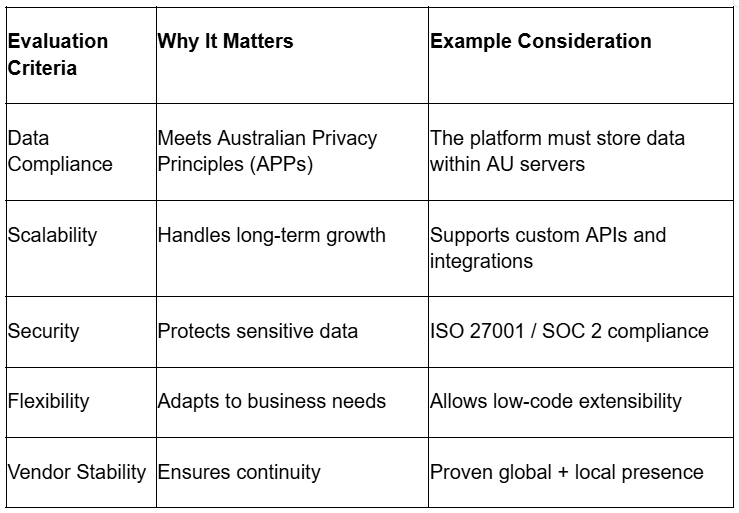
6.2. Select the Right Platform
Choosing the right platform is crucial. Australian businesses must consider factors such as:
- Data sovereignty — Ensure hosting within Australian or compliant data centres.
- Scalability — Assess support for API integrations, custom logic, and user growth.
- Security certifications — Look for ISO 27001, SOC 2, or IRAP-compliant platforms.
- Ecosystem and support — Choose vendors with active developer communities and local or regional support teams.
6.3. Establish Governance and Oversight
Lack of governance over decentralized apps, which are being developed by their users, could be inefficient or unsafe. Establishing a Center of Excellence (CoE), which defines standard code practices, version control practices, who has access to applications, security policies, etc., will help facilitate collaboration among IT and Business departments, while still maintaining the appropriate level of oversight.
6.4. Start Small, Scale Gradually
Using a "Pilot" type of project, such as building an internal dashboard or automating an existing internal workflow, will allow you to test the platform's capabilities and track your successes, such as how much time was saved developing the application, how many users adopted the application, and if there were any cost savings. Once you have proven the platform's value, you can expand to company-wide projects.
6.5. Upskill and Empower Teams
Provide ongoing training opportunities using platform-specific training sessions, certifications, and workshops to continue to empower your employees to develop and innovate within the confines of your organization. This will ultimately reduce your dependence on third-party vendors and establish a sustainable innovation culture.
6.6. Measure ROI and Iterate
Establish Key Performance Indicators (KPIs) such as Development Cycle Time, Error Reduction, Customer Satisfaction, etc. Continuously monitor and adjust your process to align with organizational goals.
In conclusion, to successfully implement no-code development in Australia, organizations must strike a balance between strategy, governance, and employee education. With careful planning and execution, organizations can accelerate innovation, foster collaboration, reduce costs, and position themselves for long-term success in today's rapidly changing digital world.
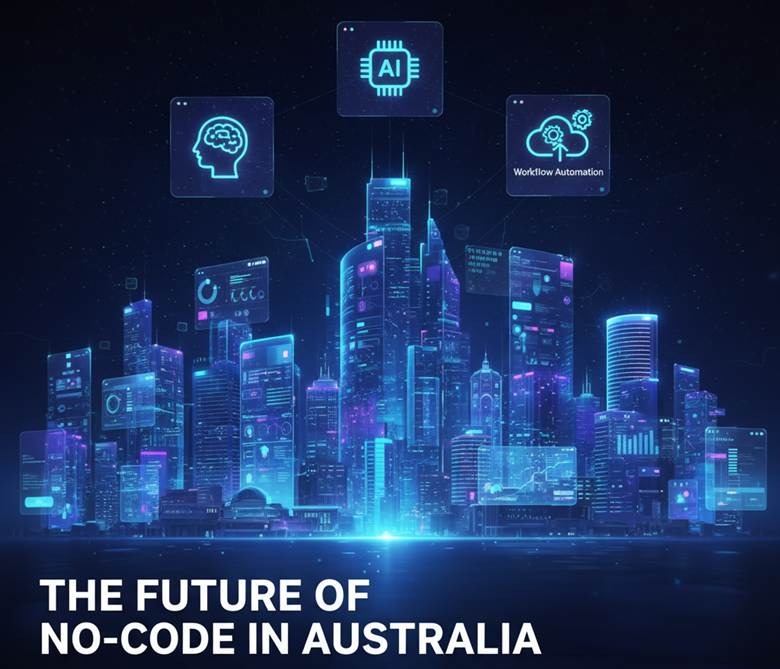
7. Future Outlook: Australia in 2025-2030
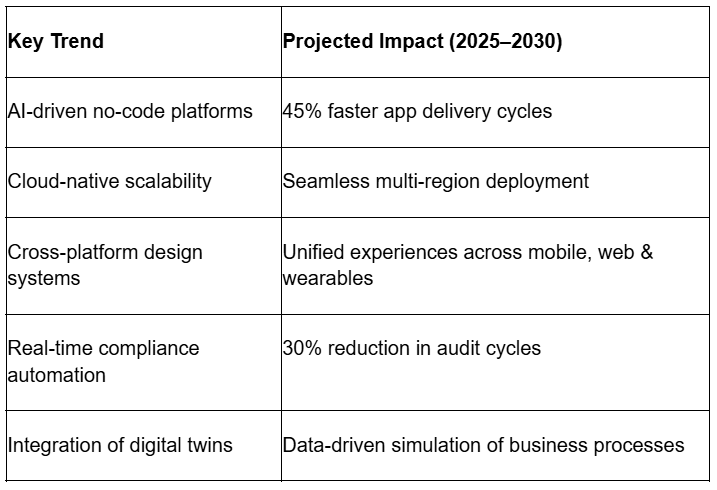
Between 2025–2030, Australia's Digital Economy will undergo a significant shift as No-Code and Low-Code Platforms transition from being niche enablement tools to mainstream acceleration engines for Australian Innovators.
7.1. A Digitally Inclusive Innovation Wave
In 2030, it is estimated that more than 60% of all new digital solutions in Australia will be either developed or supported by No-Code or Low-Code Environments. This will further help democratize innovation and allow entrepreneurs, educators, and Small and Medium Enterprises (SMEs), especially in rural/remote areas, to engage in the Digital Economy, regardless of their level of technical expertise. As a result, this will create an innovative ecosystem where ideas are driving impact faster than coding.
7.2. AI-Enhanced Development Becomes the Norm
AI will seamlessly merge into Visual Development Tools to provide auto-suggested workflows, natural language to app creation, and predictive analytics for businesses to develop their products faster, reduce costs, and increase efficiency. Businesses will increasingly use AI Copilots to speed up the development of products, automate compliance testing, and even improve user experience in real time.
7.3. The Workforce Transformation
As we move forward in time, Australia's workforce will begin to focus on hybrid-digital roles — where designers, data analysts, and domain experts all work together through visual development environments; this means that the current divisions between "IT" and "the business" will become obsolete. This will be possible because Citizen Developers 2.0 will develop production-level applications with little or no coding required.
The education sector will have an enormous role in the future of no-code, low-code, and AI-assisted visual development and will be responsible for educating the next generation of developers by making no-code and automation part of the curriculum in both STEM and Business programs. Universities and TAFES are expected to form partnerships with technology companies to provide students with hands-on experience in platforms such as FlutterFlow, Buildship, and Airtable.
7.4. Government and Sustainability
By providing funding and developing policies and programs for skill development (Digital Economy Strategy 2030), government agencies will drive the adoption of no-code technologies. Additionally, with sustainable practices becoming a national priority, governments and organizations will utilize no-code platforms to build more efficient, cost-effective, green digital solutions with minimal waste and optimal use of resources.
Overall, by 2030, no-code, low-code, and AI-assisted visual development will revolutionize how innovations happen, enabling them to occur faster, smarter, and more inclusive to everyone. The world of the future belongs to those who can think boldly and build visually.
8. Conclusion
Australia is experiencing a digital transformation powered by no-code, low-code, and AI-driven development platforms. These technologies are making it easier than ever for businesses to turn ideas into scalable applications faster, more efficiently, and at lower costs.
As the ecosystem continues to evolve, success will depend not only on choosing the right platform but also on having the right strategy and expertise to maximize its potential.
At FlutterFlowDevs, we help Australian businesses unlock the power of visual development. Our team specializes in FlutterFlow, BuildShip, and modern backend solutions to build secure, scalable, and high-performance applications across industries including FinTech, EdTech, HealthTech, AI, and SaaS.
From MVPs to enterprise-grade solutions, we partner with businesses to accelerate innovation, reduce complexity, and drive growth.
The future of software development isn't about writing more code—it's about empowering more people to build. As no-code and low-code platforms continue to reshape industries, FlutterFlowDevs is proud to help Australia build its digital future.


View more blogs
.png)
%20(1).png)

.png)
.png)
.png)

.png)


.png)
Ready to develop your own product? Get in touch today!
Get in Touch
